Ramadan 2026 arrives bearing exceptional opportunities for growth and increased revenue for your restaurant; however, it simultaneously presents one of the most high-pressure operational scenarios. During this holy month, demand doesn’t just increase—it concentrates into very narrow windows, namely Iftar and Suhoor. This makes preparing restaurants for Ramadan a strategic necessity to avoid operational crises resulting from a surge in simultaneous orders.
The true difference in Ramadan is not made by the volume of customers, but by the quality of crowd management. Crowds without efficiency mean delays and errors that cost you customer loyalty and your restaurant’s reputation. True success lies in the ability to manage dozens—sometimes hundreds—of orders with high flow and accuracy, while maintaining team composure and service quality simultaneously.
This guide serves as an integrated practical framework, starting from early inventory and HR planning to managing Iftar peaks professionally. We will also demonstrate how the Foodics system assists you at every step, granting you full control and the efficiency needed to manage your Ramadan operations with ease.
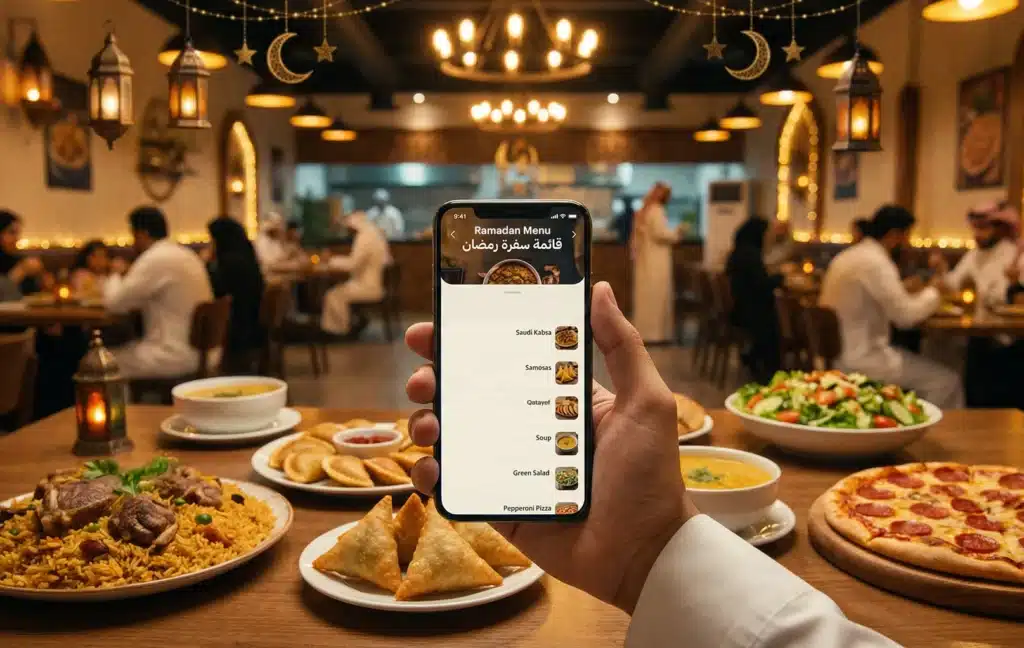
Design a Ramadan Menu that Guarantees Execution Speed
In Ramadan, a long and complex menu is your number one enemy. Success lies in designing a menu that balances what the customer loves with what your kitchen can achieve in record time before the Maghrib call to prayer.
Building Iftar and Suhoor Menus
The goal is to reduce both decision time and preparation time:
- Highlighting Best-Sellers: Make customer favorites clear and easy to access through menu engineering, guiding customers toward options your kitchen can prepare quickly.
- Eliminate Time-Consuming Dishes: Temporarily remove items that require complex preparation or long oven times, as they stall other orders during peak hours.
- Designing Family Meals: Design family meals or integrated combo deals. This simplifies the decision for the customer and unifies kitchen efforts in preparing large quantities of the same item, especially for delivery services.
How does Foodics support you in this stage?
The Foodics system supports you as a smart tool for controlling performance and profitability during Ramadan by creating and activating special menus: for example, an Iftar menu and a Suhoor menu throughout the week, and a Ramadan delivery menu. Additionally, the Menu Engineering feature allows you to identify the most popular and profitable dishes, enabling you to focus your Ramadan menu on high-margin items that ensure speed of execution and the highest return per operating hour.
Fast Tracks: Tactics to Speed Up Service During Ramadan Peaks
During peak hours before Iftar and during Suhoor service, every second spent entering or preparing an order is a second taken from your profits. The goal here is to turn your menu into a fast, high-profit production line.
1. Fast Tracks and Quick-Prep Dishes
- Identify Easy-to-Prepare Items: Highlight items that are prepared in large quantities in advance, such as rice, soup, and basic grills, and place them at the forefront of both digital and printed menus.
- Packaging and Portioning Rules: Use precise standards for portion sizes and strict packaging rules. This not only reduces waste but also minimizes returns.
2. Maximizing Profitability Through Upselling
Ramadan is the ultimate season for add-ons. Focus on items that increase the check value without straining your kitchen.
- Encourage cashiers, waiters, or use digital menus to suggest Ramadan drinks and desserts after Iftar, and side appetizers that are ready for serving.
How does the Foodics system support you in this stage?
- Modifier Settings: Set up add-on options to appear easily for the cashier to suggest to customers, ensuring no upselling opportunities are missed even during peak hours.
- Analyzing Previous Season Sales via Foodics BI: This helps you analyze last year’s data and predict which items will achieve the highest sales at specific hours. This data is useful in directing your team to focus on items that generate the greatest return with minimal effort.
Preparing Restaurants for Ramadan: How to Manage Working Hours to Handle Iftar and Suhoor Pressure?
Managing operations in Ramadan requires a delicate balance between execution speed and service quality. Success in this season does not depend on individual effort, but on turning your restaurant into an organized system that responds to order pressure with high flexibility.
Redesigning Shifts Based on Data
Redesigning shifts is the cornerstone of preparing restaurants for Ramadan. The goal is not just to increase staff, but to distribute them logically based on peak hours. A separate shift system allows you to concentrate operational energy at least two hours before Iftar and Suhoor. Using historical reports from the Foodics POS system, you can precisely identify peak times to build flexible work schedules that reduce costs and ensure readiness during the most sensitive hours.
Mastery Over Menu Diversity
In a high-pressure Ramadan environment, speed and accuracy take precedence over variety. The customer seeks an order that arrives complete and on time; therefore, simplification is the ultimate operational intelligence. Focus your restaurant team’s training on the “Core Menu” (the most requested and fastest-to-prepare items) so that execution becomes automated and swift. Reducing options and modifications decreases thinking time in the kitchen and lowers the margin for error.
Implementing a “Zero Errors” Policy in Delivery
Operational success depends on ensuring every order goes out with all its components complete. Allocate independent packaging stations to separate delivery and pickup orders, adopting clear and unified checklists. This organization prevents overlap and protects the customer experience from errors that might magnify dissatisfaction, especially during critical moments before the Maghrib prayer.
How does Foodics support you in this stage?
- Performance Tracking via Dashboard: Monitor peak hours for each branch accurately to know when you need to increase or redistribute staff based on actual demand.
- Digital Standard Recipes: Display meal ingredients and preparation methods clearly to the kitchen staff via the system to ensure consistency in quality and speed across all branches.
- Customized Interface for Ramadan: Reorganize the user interface to show Ramadan items on the first page, speeding up the order entry process and significantly reducing wait times.
- Unified Workflow: Ensure all branches adhere to the same ingredients and processes through the unified menu in the system, preventing chaos and turning operations into an organized, highly reliable flow.
Organizing Ramadan Offers and Time-Bound Discounts Effectively and Simply
In Ramadan, the goal of offers and campaigns is not just to attract customers, but to direct them toward dishes that increase your profits and make the kitchen team’s work easier. A smart offer is one that raises the average transaction value while simultaneously reducing operational complexity.
Strategies to Increase Order Value
To raise order value in Ramadan without disrupting execution speed, your strategy should be based on increasing revenue through simplifying operations. Instead of relying on scattered individual orders, “Group and Family Bundles” give you the opportunity to double the average check. At the same time, this unifies kitchen efforts around a limited number of items prepared in larger quantities and with higher efficiency, reducing operational stress. During peak hours, offer low-effort upselling, such as adding a side dish or a quick-prep dessert at an incentivized price with Iftar meals. This type of offer achieves an immediate increase in profitability without slowing down the workflow or exhausting human resources.
Strategically, entrenching a “Pre-order Culture” turns sudden pressure into a predictable load. Encouraging customers to schedule their orders before the call to prayer gives you a precise view of the required production volume and ensures the operational load is distributed evenly, raising service quality and reducing last-minute errors.
How does the Foodics system support you in this stage?
- Automating Offers and Discounts: Don’t leave calculations to the cashier’s estimation; pre-program bundled meals in the POS system so discounts are applied automatically, ensuring fast checkout and completely preventing human error.
- Control via “Foodics Online”: Receive scheduled orders through your own ordering platform, giving you full control over offers and avoiding third-party platform commissions, while ensuring orders flow to the kitchen at the times you determine.
How to Control Delivery Order Pressure Before Iftar?
Managing delivery is one of the biggest challenges for restaurants in Ramadan. Delivery orders do not come sequentially; they pour in as a single block before Iftar. If your kitchen is not technically and humanly prepared for this influx, the 30 minutes preceding the call to prayer will turn into operational chaos.
Peak Management Tactics and Rating Protection
Success in Ramadan begins with predicting demand intensity; thus, the kitchen must enter a state of maximum readiness at least one hour before Iftar, with drinks and appetizers prepared in advance. To increase efficiency, it is preferable to separate production lines by having a dedicated team for delivery and another for the dining hall, distributing tasks precisely (one for packing, another for wrapping, and a third for handover) to ensure a smooth flow. You might consider using a cloud kitchen to serve delivery orders only.
Protecting your ratings on platforms starts from within the kitchen. A single mistake or a slight delay in Ramadan can immediately translate into negative reviews that affect your sales for months.
Committing to realistic preparation times and using heat-retaining packaging is what protects you from customer dissatisfaction. Finally, adopt a “Final Inspection Protocol” to match the order with the invoice before closing it; small details like a spoon or a sauce make the difference between a “one-star” and a “five-star” rating.
Preparing the Restaurant for Ramadan: Inventory Forecasting to Avoid Stockouts
In Ramadan, an error in inventory management costs you twice: either through stockouts and lost sales opportunities or through excessive material waste. Balance here requires moving from “guesswork” to “forecasting” based on numbers to ensure service continuity at the lowest cost.
Forecasting with Data, Not Probabilities
To prepare your restaurant for Ramadan, you must return to last year’s data; it is the most honest source for predicting demand volume. Once the holy month begins, the “Daily Sales Rate” becomes your compass for dynamically adjusting purchase orders, with the necessity of determining Safety Stock for vital ingredients like proteins and packaging materials to ensure work does not stop under any circumstances.
Prioritization and Pre-preparation
- Basic Ingredients: Focus on proteins, bread, sauces, dates, and ingredients for Ramadan drinks.
- Packaging Materials: Do not overlook packaging tools such as bags, security stickers, containers, and cutlery. The lack of a single bag can stall the delivery of an entire order.
- Pre-preparation: Identify what can be safely prepared in advance and what must be prepared fresh to ensure the best use of storage space and working hours.
How does Foodics support you in this stage?
- Trend Analysis via Foodics BI: Discover the most dominant items in sales from previous seasons to intensify their purchase orders, and use the inventory management program to reduce waste and theft.
- Sales Pattern Visibility: The system provides you with a precise view of patterns by day and hour for each branch, facilitating inventory distribution among your branches according to actual need.
- Financial Visibility and Accounting Integration: Through integration with the Foodics Accounting program, you can monitor raw material costs in real-time and their impact on your profit margins, giving you full control over your cash flows and purchasing decisions.
Marketing Strategies in Ramadan: Increasing Actual Sales and Orders
In Ramadan, social media platforms are filled with advertisements. Therefore, the secret to success is not in the number of ads, but in reaching the customer at the moment they need you most, or with an offer that suits their mood.
Creating Your Weekly Marketing Campaign Schedule
- Preparation Phase (Before Ramadan): The goal here is to catch the customer’s attention. This is where the importance of advertising the Ramadan menu on social media platforms shines, highlighting Iftar bundles and opening pre-orders so your brand becomes the ready choice before the competition’s crowd begins.
- Mid-Ramadan Weeks: Focus shifts to the highest-demand items and family offers. Here, the customer seeks quality and value, so the most requested dishes should be rotated constantly, offering clear, easy-to-understand deals that increase group purchase decisions.
- The Last Ten Days: Customer behavior changes; thinking time decreases, and reliance on quick solutions increases. Here, success goes to those who focus on late Suhoor, delivery bundles, and offers, being the easiest and closest option for a customer busy with Eid preparations.
Golden Windows for Communication
There are three golden time windows for communication campaigns:
- Three to four hours before Iftar: The moment practical thinking about the day’s meal choice begins.
- After Tarawih prayers: Where behavior shifts toward coffee, sweets, and social visits.
- Suhoor time: When the customer looks for a fast and filling option without complexity.
In all these cases, the message must be brief, clear, and direct, featuring a specific offer and a single link that opens the ordering page.
How does Foodics support you in this stage?
- Loyalty System: Don’t settle for a one-time sale; use the loyalty system to reward customers who order consistently during the month, incentivizing them to return through double points on weekdays in Ramadan or exclusive rewards via app notifications.
- Customer Retention: Use data collected by the loyalty system in the CRM to send personalized offers based on the customer’s previous orders.
- SMS and Notifications: The effectiveness of SMS and mobile notifications is measured not just by the quality of phrasing, but by the precision of timing. Communication at the right moment turns a message from a mere alert into an almost immediate purchase decision.
- Direct Conversion via Foodics Online: You can create a restaurant website, app, or loyalty system through Foodics Online.
Ramadan Tents: How to Manage Your Temporary Branch with Factory Logic and Restaurant Speed?
Ramadan tents represent a true test of your restaurant’s ability to expand rapidly; success is not measured by area, but by the flow of movement that ensures service quality at your temporary location does not decline compared to your main branch.
Why is Operating Ramadan Tents a Special Challenge?
If you are considering setting up a Ramadan tent, you must prepare in advance and manage it carefully due to the influx of guests at Iftar and Suhoor. To avoid bottlenecks, adopt “Forced Simplification” by offering a limited menu featuring the most requested and least complex dishes, reducing the time burden.
The efficiency of the tent also depends on Station Engineering; the movement path must be designed in one direction to prevent crowding, with precise responsibilities distributed to each station (ordering, packing, and handover). This turns the team into a high-precision industrial production line. Most importantly, the tent must be given full operational independence with separate inventory, staff, and reports to ensure clear visibility regarding profitability and investment feasibility.
How does Foodics support you in this stage?
- Speed and Diversity of Payment Methods: The Foodics system provides fast payment interfaces supporting all electronic and cash options, such as pay-at-table or via customer screens, reducing wait times at the cashier.
- Independent Branch Reports: You can monitor the tent’s performance as a completely independent branch, making it easy for you to evaluate material consumption and investment profitability accurately.
- Menu Flexibility: You can modify the tent’s menu through Foodics to exclude slow-moving items and focus on dishes that achieve the highest profit margin, ensuring daily operational efficiency.
Quick Checklist for Ramadan Readiness and an Error-Free Season
- Adopt Menus and Meal Bundles: Finalize Iftar and Suhoor menu designs and prepare family and group offers.
- Update Working Hours and Shift Schedules: Adjust operating hours and set a plan to increase staff during peak hours.
- Schedule Offers and Ensure Capacity: Launch promotional offers and ensure the kitchen’s ability to meet heavy orders simultaneously.
- Manage Delivery Order Surge: Design a specific workflow for fast delivery orders and prepare packaging checklists to ensure quality.
- Inventory Projections and Supply Security: Prepare accurate inventory estimates and secure sufficient quantities of packaging materials.
- Integrated Marketing Plan: Readiness of content calendars, SMS campaigns, and app notifications.
- Field Operations Planning: Organize seating areas or Ramadan tents and manage guest flow.
- Eid Strategy and Loyalty Retention: Prepare an Eid operational plan and loyalty offers to ensure customers return after Ramadan.
A Final Word for a Successful Ramadan Experience
True success in the month of Ramadan is not achieved simply by opening doors to visitors; it is built behind the scenes weeks before the first Iftar order arrives. By engineering a smart menu, setting a flexible staffing plan, and relying on operational automation, you can accommodate larger numbers of guests without sacrificing food quality or even your profit margins.
Ramadan is an operational marathon; make the Foodics POS system a partner that grants you full visibility and control, allowing your team to focus on providing an unforgettable Iftar and Suhoor experience for your customers.
Discover Foodics features for restaurants in Ramadan and throughout the year. Register your details here!