Over the past few years, the restaurant and coffee shop sector has turned away from traditional ads to modern restaurant marketing strategy. Marketing is no longer limited to promotional messages. It’s become an integrated experience requiring multi-channel communication, including social media platforms, email, SMS, and mobile notifications.
Data varies based on the type of restaurant. For example, about 99% of full-service restaurants are present on at least one social media platform, while only 69% have a website. This means restaurants and cafes presence on these platforms has become essential for communicating and engaging with customers.
Roughly 49% of Facebook users search for local restaurants, while Instagram is considered the primary platform for restaurants seeking to engage with customers. Meanwhile, a Google Business Profile is critical for F&B operators as it improves their appearance in search engines through search engine optimization (SEO).
Data also shows that Gen Z and Millennials “are 99% more likely” to use social media and online restaurant reviews when choosing where to dine.
This means the success of any restaurant marketing strategy now hinges on achieving 3 interconnected goals. These are reaching the largest number of potential customers, enhancing interaction with them to build brand relationships, and converting this engagement into long-term loyalty.
In this article, we’ll focus on the top 3 platforms critical to modern coffee shop and restaurant marketing strategies. These are email, SMS, and social media. We’ll clarify the differences, when to use each, and more.
Understanding Each Restaurant Marketing Channel
To achieve stellar marketing results, you need to understand which platform suits your restaurant best.
Here’s a comparison between email marketing, SMS, and social media platform.
- Email marketing
Email is one of the most powerful marketing channels for building long-term customer relationships. It helps you tell your brand story and share exclusive offers with deeper content than any other platform.
Email is great for fostering loyalty, sending personalized rewards, and promoting offers.
Its effectiveness relies on clear key performance indicators (KPIs), such as the Open Rate, which depends on the attractiveness of your subject line. Meanwhile, the Click-Through Rate (CTR) reflects the strength of the content shared and its ability to prompt customers to take action, such as ordering or booking.
Email can transform a marketing message into a genuine loyalty tool that increases customer visits and generates continuous sales. However, email is not ideal for time-sensitive or short-duration offers, such as those lasting only a few hours.
- SMS/Text messaging
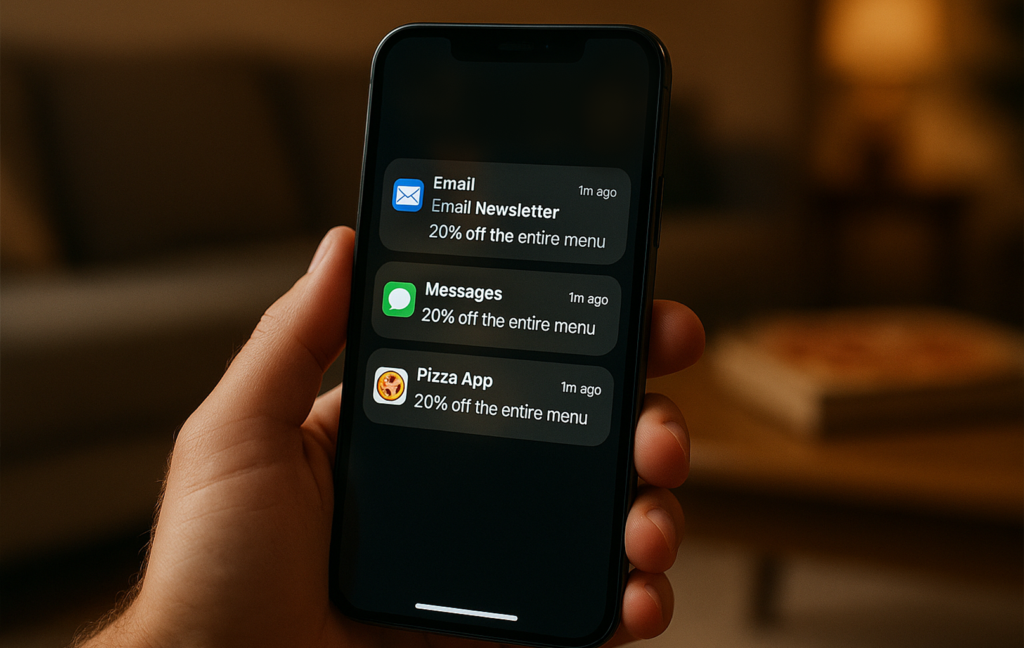
Text message marketing, or SMS marketing, is a super-fast marketing channel with nearly-guaranteed open rates. Unlike email and social media, text messages reach the customer’s phone without the need for an internet connection or platform access.
This makes it the perfect channel for urgent or quick-to-expire offers. It’s also useful for immediate alerts and confirming reservations or orders.
The effectiveness of SMS marketing depends on 2 KPIs: the Delivery Rate, which ensures your message reaches the customer, and the Response Speed, which reveals how attractive the message is and the customer’s ability to immediately interact with it.
This turns SMS from a short notification into a powerful tool for boosting sales instantly.
- Social media marketing
Social media is the most prominent platform for building your restaurant’s digital identity and attracting new customers. Use engaging visual content that reflects the dining experience before it is even started or tasted.
Social media doesn’t rely on publishing photos and offers only, but on creating an interactive community around the brand through posts, comments, engagement, and instant replies.
Its effectiveness relies on 2 main KPIs: Reach, which shows the size of the audience that viewed the content, and the Engagement Rate, which reflects the content’s impact and its ability to connect with followers.
With a well-thought-out restaurant marketing strategy, social media transforms from a showcase platform to a continuous growth tool for your brand.
Channel Comparison for Your Restaurant Marketing Strategy
| Point of comparison/ Platform | Email marketing | SMS/Text messaging | Social media marketing |
| Cost | Low-to-moderate (low cost per email) | Relatively Low, varies by country, and depends on package deals | Low (for organic content) to High (for paid campaigns) |
| Reach | Limited by subscriber counts (Customer database) | Limited by subscriber counts (but highly responsive) | Very wide (Best for reaching new customers) |
| Personalization | Very high (Can send personalized offers based on purchase history) | Very high, but the limited character count can be a problem | Low, better for targeting large groups |
| Speed/Pace | Moderate-to-slow (Requires time for design and review) | Very high and instant (Best for urgent notifications) | Instant (for posting), but relies on reach algorithms |
| Conversion rate | Moderate-to-high (With good targeting) | Very high (Due to immediacy and urgency) | Moderate-to-low (Better for building awareness, not instant sales) |
When does each channel work best?
- Email marketing: Works best for customer retention and increasing loyalty. Use it to send seasonal menus, newsletters, thank-you notes, and loyalty program rewards.
- SMS marketing: Best for immediate interaction and prompting urgent action. Use it for booking confirmations, order reminders, and quick discount notifications.
- Social media marketing: Works best for building brand awareness and attracting new customers. Use it for engagement contests, appealing visual content, announcing new branch openings, and paid campaigns targeting audiences who have not tried the restaurant before.
Common Mistakes to Avoid When Marketing Your Restaurant
Don’t waste your restaurant marketing budget. Here are the most common pitfalls to avoid when creating a restaurant marketing strategy:
- Using SMS for long, not urgent messages: Text messages are relatively expensive, so using them to tell a story or share a post doesn’t suit their instant nature and wastes your budget.
- Flooding customers with emails: Sending daily emails leads to a high unsubscribe rate and damages trust. Send email once every week or month.
- Not using a mobile-friendly design: Most customers open emails on their phones, so designing a message that doesn’t display correctly on mobile screens will negatively affect its performance.
- Not adding a CTA on social media: Posting beautiful images without a clear call-to-action (CTA) like an ordering link or asking customers to visit your site, wastes your budget and conversions.
- Ignoring engagement and customer complaints: Failing to respond to comments, inquiries, or complaints posted on your restaurant’s social pages leads to customer loss and reputation damage. Social media platforms are also customer service tools, and ignoring them indicates a lack of care.
Building a Multi-Channel Restaurant Marketing Strategy
The secret to creating successful marketing isn’t in using channels separately, but in integrating them together into a unified restaurant marketing strategy. One that follows the customer journey to ensure the right message reaches customers at the right time.
Here’s how:
- Align campaigns with customer journey stages
- In the Awareness and Attraction stage, use social media to build a first impression through engaging visual content.
- In the Decision and Conversion stage, use direct communication in the form of email for detailed offers and announcements, and SMS for instant incentive-based purchases.
- In the Loyalty and Retention stage, use email as your primary channel to strengthen the relationship with personalized content. For example, use celebratory wishes and updates to your restaurant loyalty program. Use SMS for quick reminders to maintain engagement.
- Ensure consistent messaging across all channels
Building a strong, trustworthy brand identity begins with message consistency across all your channels. Your customer must feel that they are dealing with the same entity, with the same tone, visual style, and language, whether they are on Instagram or receiving an email.
This consistency boosts trust and brand recognition. During promotional campaigns, the channels work together: social media generates attention, email provides the details, and SMS alerts the customer when the offer starts.
- The timing and frequency mix
Successful multi-channel marketing requires ensuring you’re not annoying your customers. This is the timing and frequency mix.
- Email: Send emails at a moderate pace (not more than two emails weekly, and sometimes monthly) and at appropriate times (morning/afternoon).
- SMS is used sparingly and for urgent situations only, such as a lunch offer before noon, to ensure an immediate response.
- Use social media to maintain a higher posting frequency (daily post or more) because its algorithms control reach, requiring repetition to maintain continuous visibility.
The Practical Guide to Creating Restaurant Marketing Strategies
To succeed at multi-channel restaurant marketing, you need a clear weekly marketing plan that translates your strategy into practical steps. It’s best to create a marketing plan for 1-to-3 months and then divide it into weeks.
Include days such as Saudi National Day, Halloween, Mother’s Day, International Coffee Day, and other occasions, along with special offers.
Create a weekly plan
The weekly plan starts by distributing tasks.
- Dedicate the beginning of the week to scheduling social media posts and designing the final drafts of your email newsletters.
- Mid-week, send limited-time offers via SMS messages or reminders for expiring seasonal offers.
- Review and analyze results at the end of the week and modify content based on performance.
Choose the right platforms and campaigns
There are 3 main types of marketing campaigns for restaurants and coffee shops. New menu launches combine visual social media content and an email, while seasonal offers rely on targeted SMS messages to create a sense of urgency before the rush hour.
Lastly, customer-centric loyalty programs rely on email to deliver personalized rewards and encourage customer retention.
Tips for automation and segmentation
One of the most important restaurant success strategies is customer segmentation. You can extract data from a restaurant point-of-sale (POS) system, like Foodics, which includes a customer relationship management (CRM) system, and from POS reports.
The automated marketing system ensures the right messages are sent to each customer segment at the right time.
For example, you can send a lunch offer to customers who previously ordered at the same time, or send a personalized birthday greeting to a frequent customer.
This integration, supported by customer data and behavior, transforms marketing into an intelligent system, generating continuous revenue and building lasting relationships.

Evaluate the Success of Your Restaurant Marketing Strategy
Restaurant and coffee shop marketing success isn’t limited to launching campaigns. You need to measure relevant KPIs and connect them to actual financial results.
- First: Identify your KPIs for each channel. For example, email marketing KPIs include open rate and CTR, while SMS KPIs involve response rates. Social media KPIs can include engagement and reach.
- Second: Track conversions and return on investment (ROI) through promo codes or UTM links per channel. This helps you accurately identify the source of each reservation or order, and determine the most profitable channels. Calculate your ROI by comparing the revenue generated with the campaign cost. Direct your budget towards the highest-performing channels.
- Third: Use A/B testing for continuous improvement. This allows you to test different versions of messages, subject lines, or designs to determine the most effective in terms of engagement and conversion. Scale the most successful version for optimal results.
Finally…
Marketing for restaurants and cafes no longer relies on a single channel. The challenge is in expertly understanding how each channel works, be it email for loyalty-building, SMS for prompting immediate action, or social media for increasing awareness and attracting new customers.
Using a multi-channel coffee shop or restaurant marketing strategy can help you achieve sustainable success. It requires consistent messaging, precise timing, and measurable conversions via promo codes and tracking links.
Explore leading loyalty and marketing programs across various channels via the Foodics App Marketplace.